
Read Jefferson County Deed Records by Type
Every deed that reaches the Chancery Clerk records a conveyance. The deed type tells you the form the transfer took. The parties, granting language, legal description, signatures, and recording reference fill in the rest.
| Deed Type | What It Does | Common Use |
|---|---|---|
| Warranty deed | Conveys the stated interest with written warranties | Ordinary arm's-length transfer |
| Quitclaim deed | Conveys whatever interest the grantor has | Family transfer or correction |
| Trustee or fiduciary deed | Conveys through an authorized trustee or estate representative | Trust, estate, or court-linked transfer |
| Foreclosure deed | Documents a transfer after the applicable process | Completing a foreclosure trail |
| Tax patent or deed | Documents a tax-forfeiture conveyance stage | State tax-forfeited property |
Deeds sit apart from deeds of trust, mortgages, liens, releases, and lis pendens in the land file. Those instruments can bind a parcel without being any voluntary sale from seller to buyer.
The Jefferson County Chancery Clerk Holds the Land File
Chancery Clerk Serena King's office sits at 1483 Main Street in Fayette. Mail goes to P.O. Box 145, Fayette, MS 39069. Call 601-786-3021 or fax 601-786-6009. The office records deeds, deeds of trust, leases, construction and condominium liens, federal tax liens, lis pendens, releases, and the indexes that tie them together. The county site publishes no deed-index or image viewer. Searching Jefferson County property records therefore happens at the counter or through a phone, mail, or written request. Include every party spelling variant, date, property description, and reference you have.
Search Jefferson County Deeds in Both Directions
A direct index leads with the grantor. A reverse index leads with the grantee. Run both directions and the same parcel can be followed forward or backward through time.
| Index | Name role | Best use |
|---|---|---|
| Direct | Grantor | Find how a known owner conveyed an interest |
| Reverse | Grantee | Find how a person or entity acquired an interest |
| Instrument entry | Both | Capture type, date, book/page, and land description |
Try spelling variants, spouses, trustees, estates, and entity names as you search. A shared name proves little on its own. Only the legal description anchors an index entry to the actual parcel.
Jefferson's Land Index Predates Its County Name
The MDAH county-record microfilm catalog lists land-index and deed-book reels by date, index type, and reel number. Its early finding aid starts in September 1792, before county organization in 1799 and the Jefferson name in 1802. The catalog view makes clear why an exact reel citation matters for Jefferson County deed records.
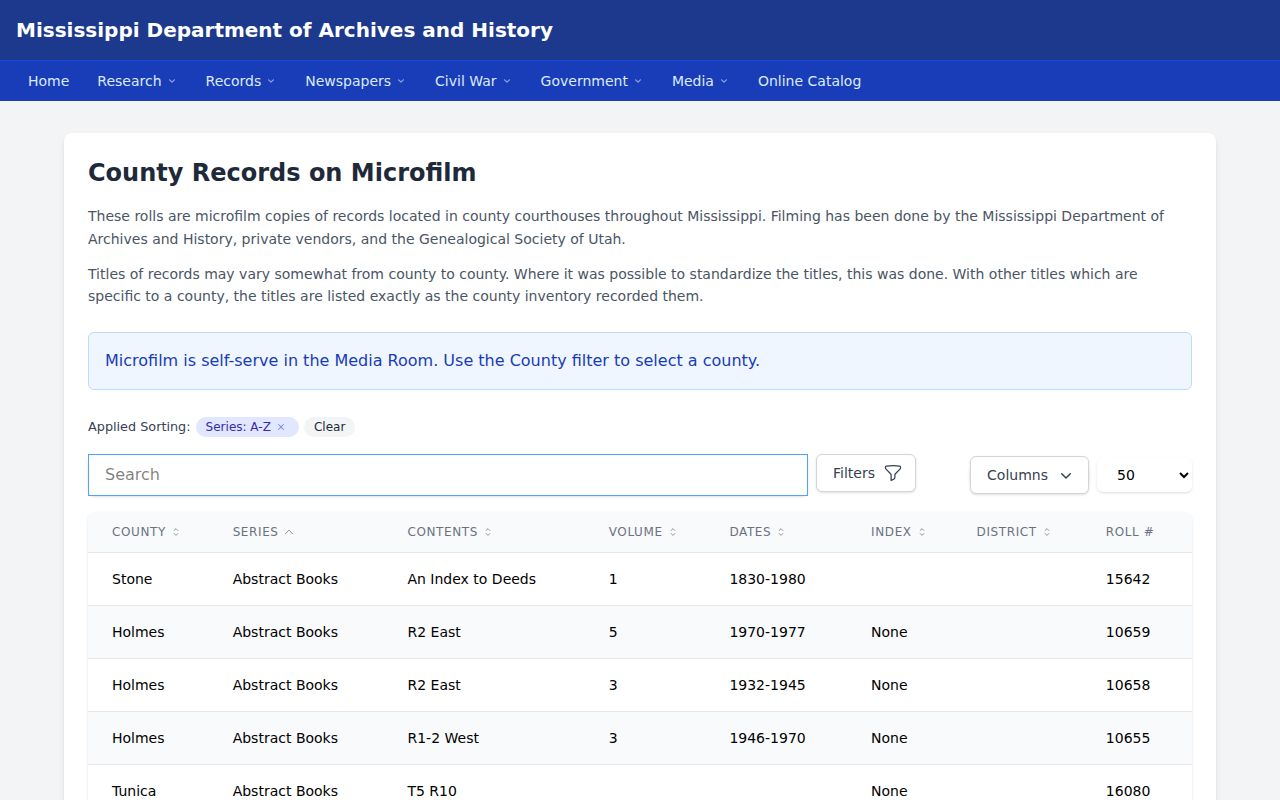
Separate year, index, and reel columns help you tell a direct deed index from a reverse index or a deed-book run before any reading-room visit. Early entries may sit under predecessor geography or older labels. Match the catalog description exactly, and keep original county volumes separate from archive microfilm.
Note: A catalog's early date states described coverage; it does not prove that every instrument in that span survives.
Follow Jefferson County Deed Records Across the Reel Breaks
The historic finding aid splits the name indexes by date and alphabet range. Direct index roll 40 and reverse index roll 41 span September 1792 through December 1929. Coverage from January 1930 through December 1980 divides differently. Direct names A through K sit on A-377 and L through Z on A-378. Reverse names split across A-379 and A-380. The 1981 through 1996 run adds four more alphabetically divided direct and reverse reels. The direct range closes in November 1996 and the reverse range in December 1996.
Deed books follow their own sequence entirely. Books A through D, covering September 1792 through December 1799, sit on roll 42. Later lettered and numbered books continue on separate rolls. Some ranges overlap, so a year alone never identifies the right volume. Carry the party role, the date, and the deed type from the index. Add the book and page too. Take everything straight into your deed-book request.
These dates describe microfilm coverage only, not a Jefferson County online deed index. Confirm the current reel title and access route with the Chancery Clerk or MDAH. Do that before you plan a visit.
Ask a Precise Question About Jefferson's 1990 Fire
A local history reports the old courthouse burned in 1990. Most records were saved, though some later disappeared. That supports a preservation question, not an assumption that any particular deed was lost. When an entry will not surface, ask whether the original, a replacement index, microfilm, or another copy survives. Write down the book, page, parties, date, and the office response. That way, one missing source never gets treated as proof that no deed existed.
Build a Jefferson County Deed Chain
Start with the newest confirmed conveyance you hold. Treat each prior grantor as your next grantee search. That discipline keeps the chain tied to a legal description rather than a repeating surname.
- Find the current owner's acquisition deed with that owner as grantee.
- Read the grantor, dates, deed type, and full legal description.
- Search that grantor as an earlier grantee and compare the land description.
- Repeat, logging book/page and gaps; move to books and microfilm as needed.
- Grantor
- The party conveying the stated interest.
- Grantee
- The party receiving it.
- Chain of title
- The linked series of conveyances affecting the same land.
- Book/page or instrument number
- The clerk's locator for the recorded document.
Use Jefferson History to Repair a Broken Name Trail
A deed chain sometimes breaks for reasons the deed books cannot explain. Probate papers, church minutes, cemetery records, and newspapers often hold the answer. These sources can reveal why an estate, surname, or place shifted before the next conveyance. Treat them as leads, not conveyances. Every finding belongs back in the Chancery or probate records before you rely on it.
One Fayette example comes from MDAH. It identifies 221 Medgar Evers Boulevard as the former 221 Poindexter Street. Test both street names where it matters. Resist applying that single change to the rest of Jefferson County, because address renamings rarely sweep an entire county at once.
Estates are the classic interruption to a simple seller-to-buyer chain. Search under the decedent, the estate, the executor, the administrator, the trustee, the heirs, and the spouse. Then look at the probate authority behind any fiduciary transfer. A newspaper notice or a cemetery date can narrow the window. Only probate files and recorded instruments, though, show how the land interest actually moved.
Order a Jefferson County Deed Copy
Ordering a copy works best when the clerk gets full details up front. Provide the parties, the deed type, and an approximate date. Add the parcel or legal description. Include the book/page or instrument number too. Ask whether a plain or certified copy suits your purpose. The county schedule lists copies at $0.50 per page. Notarial acts run $1 per page. Confirm certification, postage, page count, and current charges before sending payment.
If the ordinary request stalls, file the county public-records form instead. Older materials may live at the MDAH Winter Building reading room. Catalog and microfilm references there help staff pull the correct volume.
Say exactly what you need: the index entry, the entire deed, the attachments, or certification. A deed exhibit can carry the decisive legal description. One page may not be enough. For mail delivery, settle postage and payment in advance. For archive work, give staff the county, series, volume, dates, and reel. Similar index runs are easy to confuse.
Recorded, not guaranteed. Jefferson County deed records show instruments accepted for recording, but they do not provide a title opinion or rule out unrecorded interests, probate issues, survey conflicts, or other exceptions.