
Trace Jefferson County Former Owners
Work from the newest deed backward toward the older land books. Jefferson County publishes no online deed index. The real tools are the Chancery Clerk's direct and reverse indexes, the courthouse deed books, and microfilm copies held by the state. A current deed names the seller. That seller becomes your next buyer to chase. Along the way, keep the legal description, book, page, and recording date on a worksheet. Surnames and street labels repeat often enough to trip up a careless search.
| Source | Years It Covers | Where Held | What It Shows |
|---|---|---|---|
| Direct and reverse deed indexes | September 1792 through 1996 on listed reels | Chancery Clerk and MDAH microfilm | Grantor and grantee names leading to deeds |
| Deed books | Letter books from 1792, then numbered and A-series volumes | Chancery Clerk; copies described by MDAH | Transfer terms, parties, legal description, and references |
| Probate land series | Wills from 1792; probate deed and estate series into the twentieth century | Chancery and MDAH catalog | Estate conveyances and court-supervised transfers |
| Historic assessments | Selected years beginning in 1818 | MDAH Digital Archives | Year-specific land or personal assessment entries |
For recent owners, the Chancery Clerk comes first. Older chains reach further. The MDAH county-record microfilm catalog lists series, dates, indexes, and reel numbers for Jefferson County. A tax roll places a name on assessed land in a given year, yet only a deed conveys title.
Jefferson Deed Index Directions
Think of the direct index as a seller's list. It groups entries under the grantor, the person or entity conveying land. The reverse index flips the view to the grantee, the recipient. A paired run of direct and reverse reels covers September 1792 through December 1929. Later A-K and L-Z reels span 1930 through 1980, then 1981 through 1996. These ranges describe microfilm, not a live database.
Start with the reverse index when you know who bought. Use the direct index to learn how that owner later sold. Spelling drifts across decades. Try initials, spouse names, trustees, estates, and legal entities. Match the legal description, not the name. When a reel citation leads into a newer courthouse volume, the Jefferson County Chancery Clerk can supply the current index and request key.
Note: Keep direct and reverse results apart, because one person may buy a Jefferson parcel and sell another in the same year.
Reconstruct Jefferson Ownership Backward
Each confirmed transfer becomes a fresh search key. That is the whole method of a backward chain. Begin with a current deed reference from the assessor, MARIS attributes, or Chancery. Then read the instrument itself whenever possible. An index entry only points the way; the deed holds the legal description and granting terms that prove it concerns the same Jefferson County property.
- Find the deed by which the present roll owner acquired the parcel. Record both parties, date, deed type, and book/page or instrument key.
- Move the grantor into the grantee side of an earlier index. Search back before the sale date and confirm the same legal description.
- Repeat the transfer link. Keep every deed reference, and note changes in acreage, lot description, or parcel shape.
- When a name link fails, test probate deeds, estate settlements, trust deeds, releases, spouse names, and court files.
- Move from current courthouse tools to the proper historic reel or deed book when the local index no longer covers the period.
- Grantor
- The party conveying the interest shown by the deed.
- Grantee
- The party receiving the interest shown by the deed.
- Chain of title
- The linked sequence of instruments affecting the same land.
- Reverse index
- An index arranged by grantee, useful for finding how a past owner acquired land.
- Warranty and quitclaim
- Different deed forms. Their labels do not remove the need to read the granting language and description.
Jefferson's Early Deed Books
Jefferson's deed books start with letters. Books A-D run September 1792 through December 1799. E-J reaches June 1810, and later letter pairs continue to Y-Z in 1846. Numbered books take over from there. Books 1-2 cover 1846 through 1851, and the runs continue into the twentieth century. Date ranges overlap in spots. One year can sit in more than one volume, so never assume a tidy match.
Frame a request with the MDAH Jefferson County finding aid, then confirm the exact series and reel with MDAH or Chancery. Microfilm can be viewed in the MDAH Media Room. The original often stays at the courthouse. Chancery accepts walk-ins, calls to 601-786-3021, mail to P.O. Box 145 in Fayette, or the county's written public-record request form. Cite names, an approximate date, the record type, and any book and page you know. The MDAH county-record catalog maps years, indexes, and reels.
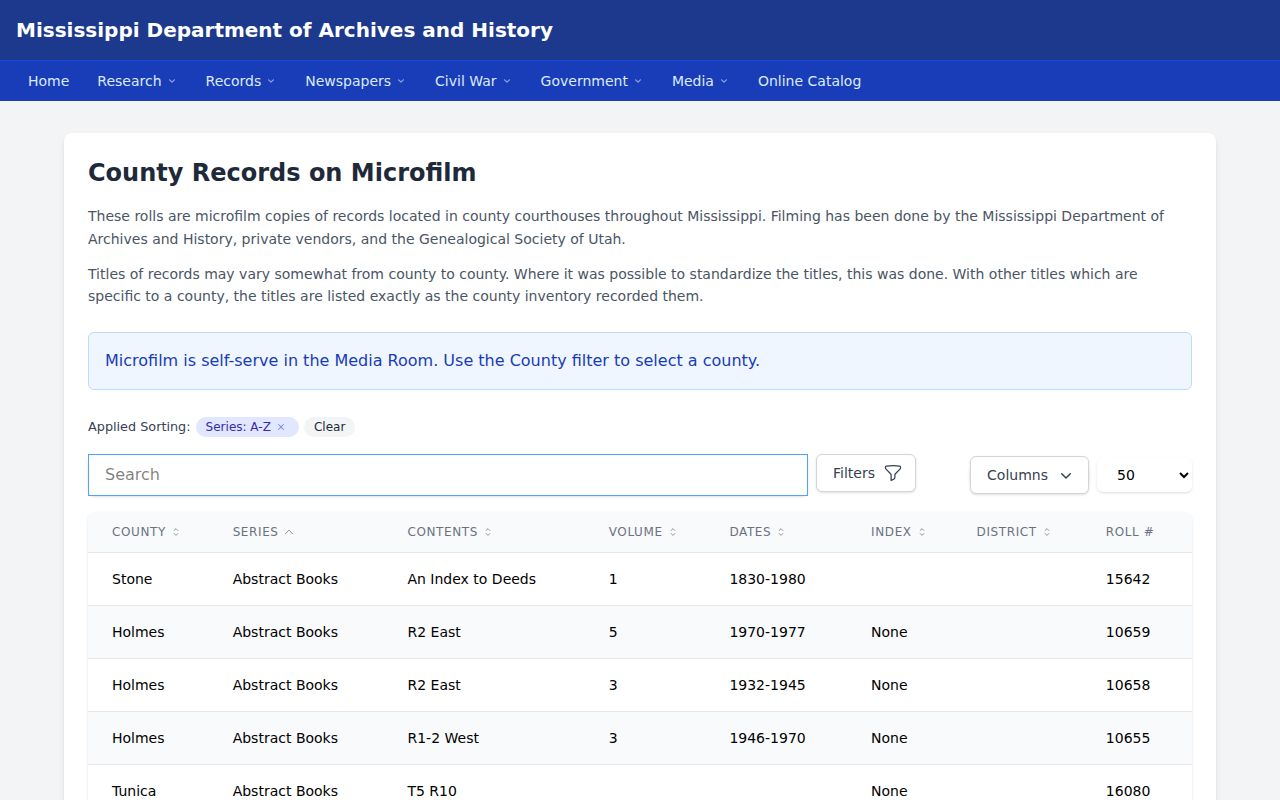
The catalog pinpoints a series, never a certified deed.
Estate Transfers in Jefferson Records
A clean chain of sales can halt at a death. Jefferson's archival coverage softens that wall. Wills are indexed from 1792 through 1995. Probate deed books, deeds of conveyance, administrator and executor bonds, and estate settlements run deep into the twentieth century. Those files show how land reached heirs or how a fiduciary sold it. An assessor roll may still list a decedent while the estate stays open.
Search the decedent's name in will and estate indexes. Identify the representative and heirs. Then return to the deed index under those names. A court order alone may not be the final land instrument, so capture the probate case reference and any later fiduciary deed. When the local file is old, the MDAH genealogy research route links courthouse originals with microfilm and archive holdings.
Old Jefferson Property Names Matter
Old names open doors that modern addresses close. MDAH files the Gov. Charles Clark/Hughes-Clark House at 221 Medgar Evers Boulevard under its earlier address, 221 Poindexter Street. A Jefferson County property search should try both forms. Rural deeds often skip street numbers entirely. Instead they lean on section, township, and range. They also lean on waterways, roads, plantations, churches, cemeteries, and neighboring owners. The official county map lists Fayette, Lorman, Rodney, Union Church, and Church Hill. Treat those as search clues, not as interchangeable municipalities or subdivisions.
Preserve the wording in each older deed. A plat reference or a prior deed citation can bridge the chain. That bridge matters once the address disappears. MDAH's historic property search accepts property name, street number, street name, city, and county. A named-site match there can sharpen the next courthouse request for deed records.
Address clue. Test both 221 Medgar Evers Boulevard and former 221 Poindexter Street when researching that Fayette property.
Jefferson History Fills Chain Gaps
Dead ends in the deed trail often yield to newspapers and local manuscripts. Mississippi State University holds Fayette Chronicle microfilm from 1896 into 1949, plus older Jefferson titles. None of it is digitized or indexed. A request therefore needs a narrow date. Legal notices, estate sales, tax-sale notices, and obituaries all serve as leads. Each one still requires confirmation in Chancery or probate records before it counts.
The Jones-Smith Plantation Journal adds Jefferson County entries from the 1870s. It also holds later continuation entries. Sale and plantation contracts from the 1890s appear there too. Church minutes and cemetery records cover Church Hill, Rodney, and Union Church. These records help separate people and places that share a name. Such sources supply context, not title. For archive visits, the MDAH Winter Building reading room issues free reader cards with photo ID. It also posts media-room and archives hours.
Jefferson's Courthouse Fire Caution
A local courthouse history reports that the old courthouse burned in 1990. Most records were saved. Yet some materials described as saved were later lost. Treat that as a warning, not a full retention account. Do not assume a record is gone. Ask the Chincery Clerk and MDAH whether the needed series survives. It might be an original, a courthouse copy, a microfilm copy, or an archive box. The MDAH Jefferson finding aid documents surviving county series and their date ranges.
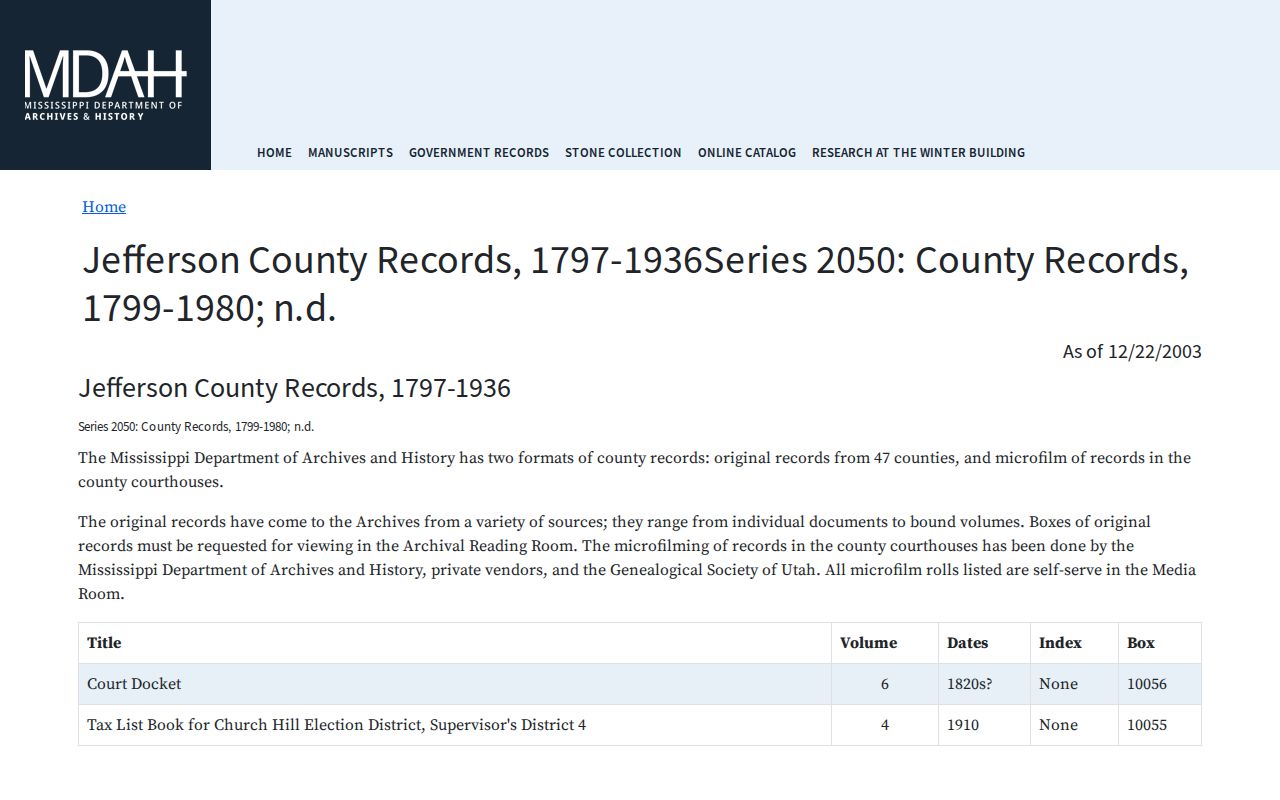
The finding aid is a starting inventory for a gap check. It does not prove every record from the stated years survives. A missing index result never proves a deed did not exist. It may point to damaged records. It may point to an unindexed volume, a spelling variant, or a file shifted into another series. Anyone documenting a search should cite exactly what was examined. That includes index direction, surname range, date range, reel, volume, and page. That written trail keeps a gap from turning into a false claim about former owners.
Note: Jefferson Chancery's electronic milestone is its 2019 MEC launch. It is not a deed-imaging date or an online land-index cutoff.
Jefferson Ownership Records Reach Back
The archival direct and reverse land indexes begin in September 1792. That date predates the county itself. Jefferson was organized as Pickering in 1799 and took its present name in 1802. A finding aid lists coverage. That is not proof every early entry concerns today's boundaries. Record the original district or county wording, and follow each instrument as written.
The county publishes no online deed index. No official cutoff for a live index can be stated here. Named microfilm series reach through 1996. Anything newer, or any original record, remains a question for the Chancery Clerk. A full title conclusion may also demand liens and releases. Probate records, plats, surveys, and legal review can come into play too. Research into former owners can reconstruct history without becoming a title opinion on the property.
Lawful use. Jefferson County former-owner records support house history, estate work, and property diligence. Never use them to track, threaten, or harass a living person.