
What Jefferson County Property Tax Records Contain
Read the two files side by side. The Assessor's assessment roll explains the taxable base behind a Jefferson County parcel, while the Collector's account confirms what was charged and whether it was paid.
| Field | What It Shows | Where |
|---|---|---|
| True or market value | Starting appraisal estimate | Tax Assessor |
| Assessed value | True value multiplied by the class ratio | Tax Assessor |
| Class and exemption | Classification and homestead treatment | Tax Assessor |
| Bill and status | Tax due, receipt, balance, or delinquency | Tax Collector |
| Millage | Applicable levy components | Collector and DOR data |
Assessed value is not sale price. A paid bill proves nothing about title either, since ownership rests in the Chancery land trail of deeds and plat records, not the tax roll.
Jefferson's Assessor and Collector Have Different Jobs
Tax Assessor Samantha Franklin-Jackson locates, classifies, and assesses property each year, maintains the ownership maps, presents the rolls, and administers homestead exemptions. The Tax Collector collects real-property taxes, records payments, arranges installments, and runs the delinquent-tax process.
Both offices sit at 1483 Main Street, P.O. Box 357, Fayette, MS 39069, and share 601-786-3781. Say what you need when you call. Values and exemptions belong to the Assessor; balances, receipts, interest, and tax-sale status belong to the Collector.
Apply Mississippi's Formula to a Jefferson Assessment
The DOR appraisal guidance walks the same three steps every county follows: start with true value, apply a ratio, then apply millage. Real property must be revalued at least once every four years.
| Term | Meaning | Use |
|---|---|---|
| True value | Market-value starting point | Base before classification |
| Assessment ratio | Percentage set by class | Converts true to assessed value |
| Assessed value | True value times ratio | Base before millage and relief |
| Mill | One one-thousandth | Levy applied to assessed value |
Class I owner-occupied residential property carries a 10 percent ratio. Class II, covering other real property, carries 15 percent. Both ratios are statewide rules, not a judgment about any particular Jefferson parcel's worth.
Prepare Jefferson Homestead Papers Before Filing
The DOR guidance sets a filing window of January 1 through April 1. An owner must generally have owned and occupied the primary home on January 1. Reapply after any change in ownership, use, or occupancy.
The Jefferson worksheet is prep, not the application itself. It gathers owner and spouse details. Addresses and marital status come next. It also lists the prior owner, deed dates, purchase figures, and vehicle tags. Age, disability, and veteran prompts appear too. Bring the deed and closing papers, and confirm eligibility with the Assessor before filing.
Look Up a Jefferson County Tax Bill Offline
The county publishes no online tax-account search. Use the Collector's counter, telephone, mail, or IVR line at 866-558-0478, and identify the parcel precisely when you ask.
- Gather the situs address, owner, tax year, and each parcel key.
- Ask the Assessor for value, class, and exemption status.
- Ask the Collector for the bill, installments, receipts, balance, and delinquency.
- Confirm whether an advertised sale, redemption, or later forfeiture applies.
Jefferson County's official site posts office information and forms. It offers no parcel-card or tax-account result screen, so a precise request does the work. Give the parcel number or owner of record, not just a street name. When a telephone answer is not enough, use the county public-records request form. It is the right route whenever you need a dated copy. That copy can be an assessment, receipt, or tax-sale document.
| Request field | Why include it | Ask of |
|---|---|---|
| Parcel, PPIN, or CAMA number | Separates similarly addressed tracts | Assessor and Collector |
| Situs and owner name | Provides a fallback when the parcel key is unknown | Assessor |
| Tax or roll year | Keeps current and historical figures apart | Both offices |
| Document wanted | Identifies roll entry, bill, receipt, delinquency, or sale notice | Correct custodian |
| Preferred format and fee estimate | Controls copying and delivery costs | Records custodian |
- Assessed value
- True value multiplied by the class ratio.
- Millage or levy
- The rate applied to assessed value.
- Homestead exemption
- Relief for qualifying owner-occupied property.
- Tax lien
- A claim arising from unpaid tax, subject to official status checks.
Read Jefferson Installments as Collection Records
The Collector page sets the rules for installments. The first real-property payment must be at least half. It is due by February 1 following the tax year. Second and third installments draw one percent interest per month. Confirm the amount, date, and receipt on the parcel account itself. The IVR number, 866-558-0478, is a payment channel. It is not a substitute for a dated ledger or receipt from the custodian.
A map or assessment value never proves tax was paid. Keep tax year, bill year, payment date, and deed date separate. For multi-year work, request a line-by-line payment history. It should show each installment, posting date, interest or penalty, reversal, balance, and receipt reference. That ledger distinguishes a late installment from an account still unpaid.
Search Jefferson Tax-Forfeited Land on the 2025 State Map
The SOS Tax-Forfeited Inventory GIS lets you search state inventory by county, address, parcel, PPIN, value range, assessed owner, legal description, section, township, and range. It is not the current tax roll. The official map page displays those inventory controls for a Jefferson County property tax lead.
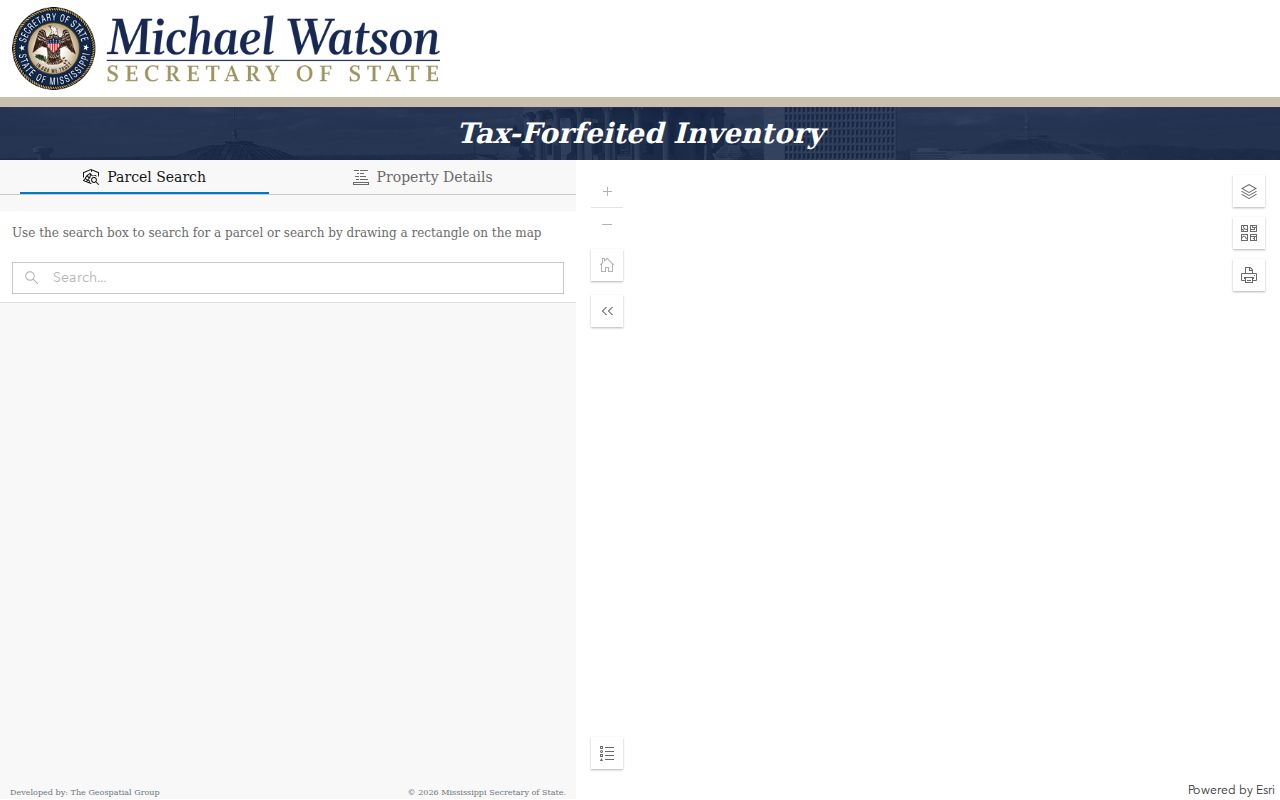
Confirm county delinquency, redemption, application, title investigation, and patent or deed stages with the proper custodians. The May 23, 2025 announcement notes that the map added county, parcel, PPIN, and user-area search.
Separate Jefferson Delinquency, Sale, and Forfeiture
A delinquent bill, a sale notice, a county tax sale, a redemption period, a state inventory entry, an active application, and a final patent or deed are distinct events. Each one means something different. The Collector must advertise an annual sale. It covers unpaid real-estate taxes and special assessments. State guidance allows tax sales on the first Monday in April. It also allows them on the last Monday in August. The exact Jefferson date, location, list, and redemption terms require confirmation from the Collector and the Chancery Clerk. Those details control the process.
| Stage | First source | Confirm |
|---|---|---|
| Unpaid bill | Tax Collector | Year, balance, penalties |
| County sale | Collector, Chancery, notice | Date, land description, redemption |
| State forfeiture | SOS inventory | Application, title work, patent or deed |
Jefferson County publishes no online delinquent list or sale-result screen. Request the current notice directly. Treat any listing as a starting point. An inventory entry or application can omit liens, access issues, or survey questions. It can also omit redemption activity or a later cancellation. Verify the final instrument in the Chancery land record. Do not treat any stage as a transfer of ownership before that.
Challenge a Jefferson County Assessment on Time
Ask the Assessor for the notice, roll entry, classification, valuation basis, and local objection calendar. Jefferson publishes no county-specific appeal form or Board calendar. DOR describes 60 days from notice for a DOR review-board appeal. Local objections instead follow the notice and statutory route.
Ask how Miss. Code §§27-35-83, 27-35-89, 27-35-93, and 27-35-119 apply to your parcel. Keep the envelope or delivery date, comparable evidence, photographs, and correction documents together.
Protect the deadline. Contact the Assessor when the notice arrives, request the controlling local date in writing, and preserve proof of delivery and filing.
Request Older Jefferson Tax Rolls Beyond the Current Account
A current tax bill answers this year's question. Older Jefferson County property tax records serve a different purpose. They let you compare past classifications, improvements, acreage, exemptions, or valuation changes against today's account. The Assessor can say whether the roll you need still sits in that office or has passed to county records management. The Chancery Clerk handles what ages out. Older land rolls and tax receipts move to storage or disposal after their active lifespan ends, so the record series and year are essential routing details.
Archives hold much of what survives. For material that has left the courthouse, the Mississippi Department of Archives and History Jefferson finding aid catalogs the county tax and court material still in existence, and its digital land assessment series opens Jefferson land and personal assessment records year by year. Read each roll on its own terms. A historic roll records the value and taxpayer conventions of its era, not today's owner, boundary, exemption eligibility, or unpaid balance.
Put your copy request in writing. Name the tax or land-roll series, the year, the owner as then listed, the parcel or legal description, and your preferred copy format. If the file moved, ask who keeps it now. Mississippi's public-records rules permit charges for actual search, review, duplication, and mailing. Request a fee estimate for any broad historical search.
| Historical question | Record to request | Cross-check |
|---|---|---|
| Did the taxable value change? | Assessment roll entries for both years | Class, acreage, and improvements |
| Was relief applied? | Exemption status for the tax year | Owner and occupancy change |
| Was the charge paid? | Collector ledger and receipt | Posting date and balance |
| Did delinquency become a sale? | Sale notice and result | Redemption and Chancery instrument |
Work year by year. That habit prevents a common mismatch, comparing one year's assessed value against a different year's millage, exemption, or payment, and it stops an archival taxpayer listing from being read as a current ownership finding. Ownership moves to the recorded deed. Boundaries rest on the deed and survey. An assessment map alone will not settle either question.
Note: Connect an older roll to modern property records through its legal description and parcel identifiers rather than relying on the taxpayer name alone.
Ask whether the supplied page is the original roll, an amended roll, or a later abstract. Record that label with the tax year. Later comparisons should use like records.
Do Not Treat Jefferson Tax Rolls as Sale History
Tax rolls follow appraisal, class, and levy rules. They report true value, assessed value, and tax due. Recorded consideration belongs to the deed trail instead. It may reflect facts unlike an open-market deal. Neither figure is a current private appraisal. The Jefferson County property value guide untangles the value terms. For ownership, request the newest recorded deed rather than assuming the taxpayer name proves title.